Bathroom Leak, Hidden Mold and Three Floors of Water Damage in East Quogue, NY
An upstairs bathroom leak in an East Quogue home ran through the dining room ceiling and into the basement. Mold turned up behind the bathroom wall once the wet materials came out.
Tom Cwalinsky··9 min read·East Quogue, NY
When the water supply line to an upstairs toilet failed in an East Quogue, NY home, water ran through the dining room and kitchen ceilings and into the basement below. Once the wet bathroom materials were opened up, the crew also found mold growing at the base of the bathroom wall. K.O.S. Restoration, an IICRC-certified water damage and mold remediation company serving the Hamptons since 2006, mapped the moisture on all three levels, protected the house, opened the affected ceilings, removed wet insulation and drywall, and remediated the mold under containment with HEPA vacuuming and an enzyme cleaner. Commercial drying equipment is now running on every affected floor, and the house won't be rebuilt until moisture readings confirm the structure is dry.
How one toilet supply line reached three floors
The homeowner called us after water started showing up on the ceiling downstairs. The source was the upstairs bathroom, where the supply line feeding the toilet had failed. A toilet supply line is a small part, but it's under full household water pressure. When one fails, it keeps running until someone shuts the valve.
Water doesn't stay where it starts. It soaked into the bathroom subfloor, ran along the floor joists, came through the dining room and kitchen ceilings on the main floor, and kept going down into the basement ceiling below. By the time the stain showed downstairs, the materials in between had been wet for a while.
That pattern is common in East Quogue and across the Town of Southampton, where a lot of homes have finished living space stacked over a finished or semi-finished basement. Every ceiling and wall cavity between the leak and the lowest floor is a place water can sit unseen.
Mapping the moisture before anything came down
Before opening a single ceiling, our technicians traced the water with moisture meters and thermal imaging. They took readings on the kitchen ceiling, across the hardwood, and inside the dining room ceiling cavity, then worked outward until they found dry material on every side.
Checking the kitchen ceiling under the bathroom. The stain shows where water reached the drywall; the meter shows how wet it is.
That map decides what gets removed and what gets dried in place. Here, the readings showed that the dining room ceiling drywall and insulation, part of the basement ceiling, and the bathroom floor were too wet to save. Anything that read wet but could still be dried, like the surrounding framing and finished surfaces, was left in place and brought into the drying plan instead of torn out.
The tools behind the moisture map
Pin and pinless moisture meters give a number for how wet drywall, wood framing and subfloor actually are. Wood that feels dry to the touch can still be well above a safe moisture level.
Thermal imaging cameras show temperature differences across a ceiling or wall. Evaporating water reads cooler, so a thermal camera shows where to take meter readings before anything is opened. Thermal finds the suspect areas; the meter confirms them.
Dry reference readings taken from unaffected parts of the same house set the target. A material counts as dry when it matches the dry reading for that material in that home, not a general guess.
A reading inside the opened ceiling cavity. Wet insulation was holding water against the framing.
Mold behind the bathroom wall
The job changed once the damaged bathroom materials were opened up. At the bottom of the bathroom wall, along the tile line, the drywall had dark mold growth and water staining. Moisture had been trapped behind the tile with nowhere to go.
Mold at the base of the bathroom wall, found while the wet materials were being opened up.
At that point the job became a mold remediation project as well as a water damage restoration. That meant containment before any more demolition, so spores disturbed in the bathroom couldn't travel through the house on the airflow from the drying equipment.
Finding mold partway through a water job is common. Water from a slow or unnoticed leak sits behind tile, under flooring and inside wall cavities long before it shows on a ceiling. Mold can start on wet drywall and wood within 24 to 48 hours. Finding it doesn't mean the job went wrong. It's the reason wet materials get opened up instead of painted over.
Protecting the rest of the house first
A water damage job with mold in it involves tearing out materials, bagging debris and carrying it through finished rooms. Before any of that started, the crew protected everything that wasn't damaged:
Floors: Ram Board laid over the hardwood in the work paths and taped at the edges.
Stairs: protective film over the stair runner so debris couldn't be tracked up and down.
Contents: the dining table wrapped in plastic, the chandelier bagged, and the basement shelving sealed in plastic sheeting.
Containment: plastic barriers zipped and taped off around the work areas.
Stair protection went down before the first bag of debris came downstairs.
Ram Board over the hallway floor outside the bathroom.
Opening the ceilings and removing wet materials
With the house protected, the crew removed what the moisture map had flagged:
the dining room ceiling drywall and the fiberglass insulation above it
the affected section of the basement ceiling and its insulation
the bathroom floor tile and underlayment, down to the subfloor
Everything was bagged at the point of removal and carried out through the garage so contaminated debris never crossed clean rooms.
The dining room ceiling opened up. The insulation above it was holding water against the joists.
Wet insulation was bagged on the spot in the basement, next to shelving the crew had sealed in plastic.
The removal is only as wide as the moisture map requires. Taking out too little leaves wet material that grows mold later; taking out too much makes the rebuild bigger than it needs to be.
Mold remediation: HEPA vacuuming and hand cleaning
With the framing exposed, the crew cleaned the structure:
HEPA vacuuming every exposed joist, subfloor and top plate, so loose spores and debris are captured rather than blown around.
Hand-wiping the framing to remove what the vacuum leaves behind.
Enzyme cleaner applied to the cleaned surfaces. Enzyme cleaners break down the organic material mold feeds on and lift residue out of the wood grain, without the harsh fumes of bleach.
Bagging and removing contaminated debris inside the containment.
Bleach isn't part of the process. It whitens mold on the surface, but its water content soaks into porous wood and drywall, and it doesn't remove the growth. That's why professional remediation removes mold physically instead of spraying over it.
HEPA vacuuming the exposed basement joists.
Hand cleaning the framing after vacuuming.
The IICRC process behind the job
The IICRC (Institute of Inspection, Cleaning and Restoration Certification) publishes the standards restoration companies are trained and certified to. This job followed two of them:
IICRC S500, water damage restoration: find and stop the source, classify how wet the structure is, remove what can't be dried, then dry the rest with controlled airflow and dehumidification, verified with moisture readings.
IICRC S520, mold remediation: contain the affected area, keep it under control while work is done, physically remove the growth and the materials it has ruined, clean what stays, and correct the moisture that caused it.
Both standards say the same thing in different ways: the moisture has to be fixed, or the problem comes back. Remediating mold without drying the structure, or drying a structure without removing the mold, only does half the job.
The bathroom subfloor after the tile came up, checked with a meter before drying.
Drying three levels at once
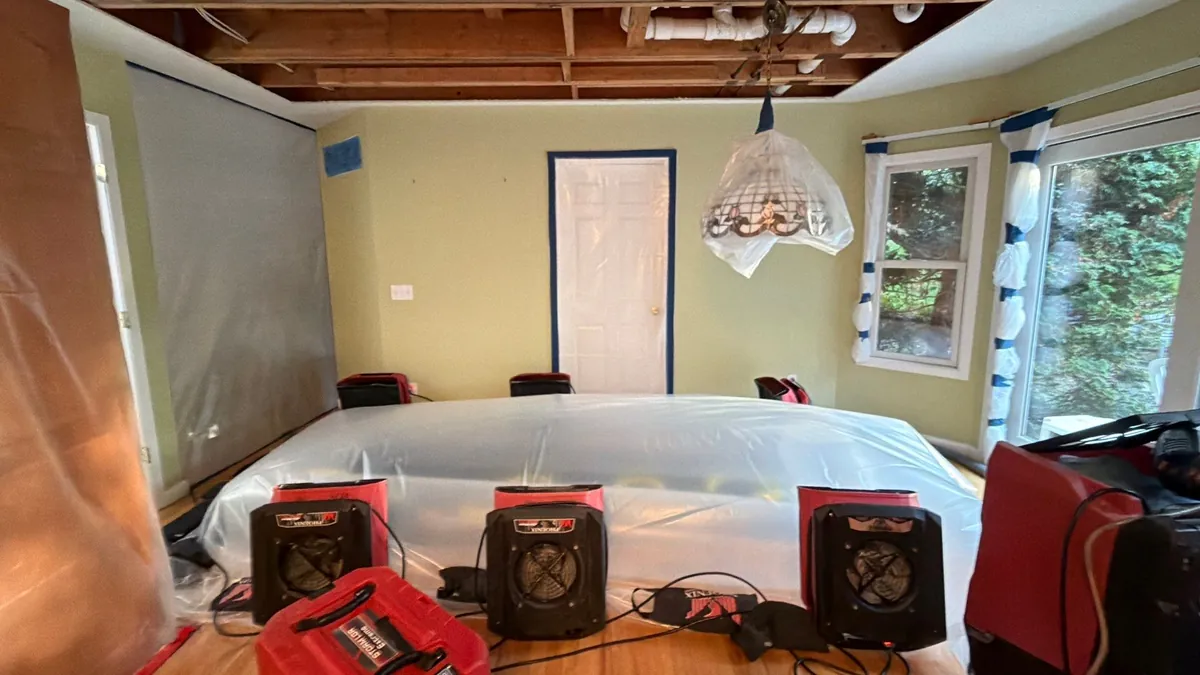
Removing wet materials doesn't finish a water damage job. The framing, subfloor and concrete underneath still hold water, and leaving it there is how mold starts again behind the new drywall. The crew set up drying equipment in the bathroom, the dining room and the basement, each working together:
Air movers push a fast, low layer of air across wet surfaces. Moving air pulls moisture out of the material and into the room, the way wind dries a wet sidewalk faster than still air.
Commercial dehumidifiers pull that moisture back out of the air. Without them, air movers only make the room more humid and the water settles somewhere else in the house.
Opened cavities let both reach the framing directly. That's the other reason the wet ceilings came down: drying equipment can't dry a joist it can't reach through drywall and insulation.
The balance matters. Too few dehumidifiers for the number of air movers and the house gets humid; too few air movers and the drying stalls. The IICRC S500 standard sets how the equipment is sized to the space and the amount of water involved.
Drying equipment in the basement. The shelving stays sealed until the job is done.
The dining room drying setup, with the table wrapped and the opened ceiling above.
Where the job stands
The demolition and mold remediation are finished, and the house is in the drying phase. The equipment stays in place and keeps working until moisture readings in the framing and subfloor match the dry reference readings for this home.
Rebuilding waits for those readings. Closing up framing that's still wet traps the moisture behind new drywall, and that's how the same mold comes back a few months later. On a job that reached three levels, drying usually takes several days, and the readings, not the calendar, decide when it's done.
What to do after an upstairs leak
If water from an upstairs bathroom or plumbing fixture shows up on a ceiling below, these steps limit the damage:
Stop the water. Shut the fixture's supply valve or the main shutoff.
Turn off power to any light fixture or outlet in a wet ceiling.
Don't trust what you can see. A small ceiling stain usually means much more water in the cavity above it.
Don't disturb visible mold. Scraping or spraying it sends spores through the house.
Get moisture readings taken on every level below the leak, not only where the stain is.
Start professional drying quickly. Mold can begin within 24 to 48 hours on wet materials.
Call your insurance company and keep photos of everything before it's removed.
If a leak has reached the floor below, call (631) 560-8999 any time, day or night. We're IICRC-certified, we've served the East End since 2006, and we'll find out how far the water went before anything comes down.
The things people ask when they're looking at the same problem.
Can a bathroom leak cause mold behind tile?+
Yes. Tile and grout look waterproof, but water that gets past a failed seal, supply line or drain soaks the drywall and subfloor behind and under them. That moisture can't evaporate through the tile, so it stays wet long enough for mold to grow. In this East Quogue home, the mold only became visible once the damaged bathroom materials were opened up.
Why does ceiling insulation have to come out after a leak?+
Fiberglass batts hold water against the ceiling and the framing above it, and the paper facing feeds mold. Wet insulation also blocks airflow, so the cavity can't dry while it's in place. Pulling it out lets the dehumidifiers reach the joists and subfloor and lets the crew confirm with a meter that the structure is actually dry.
How long does structural drying take after a multi-level leak?+
Usually three to five days once the wet materials are out, but it depends on how long the water ran, what it soaked and how many levels it reached. The equipment stays until moisture readings in the framing and subfloor match the dry reference readings for that home. The timeline comes from the readings, not the calendar.
Why use an enzyme cleaner instead of bleach on mold?+
Bleach whitens mold on the surface but doesn't remove it, and its water content soaks into porous wood and drywall. Enzyme cleaners break down the organic residue mold feeds on and lift it out of the wood grain. Under the IICRC S520 standard, the mold itself is physically removed by HEPA vacuuming and hand cleaning first; the cleaner finishes the surfaces that stay.
If mold is found partway through a water damage job, is it covered by insurance?+
It often is, when the mold is a direct result of a sudden and accidental leak that's already covered. Policies vary, and many cap mold coverage at a set dollar amount. K.O.S. documents the mold with photos, moisture readings and a written scope at the moment it's found, which gives the adjuster what they need to decide.
Do you handle water damage and mold remediation in East Quogue?+
Yes. K.O.S. Restoration provides 24/7 water damage restoration and mold remediation in East Quogue and across the Town of Southampton and the Hamptons, with an average arrival time of 45 minutes in Suffolk County. Call (631) 560-8999.