

Where asbestos is in Long Island houses.
Four materials account for nearly every residential abatement here. If your house is pre-1980, assume at least one is present until a survey says otherwise.
Asbestos pipe & boiler insulation
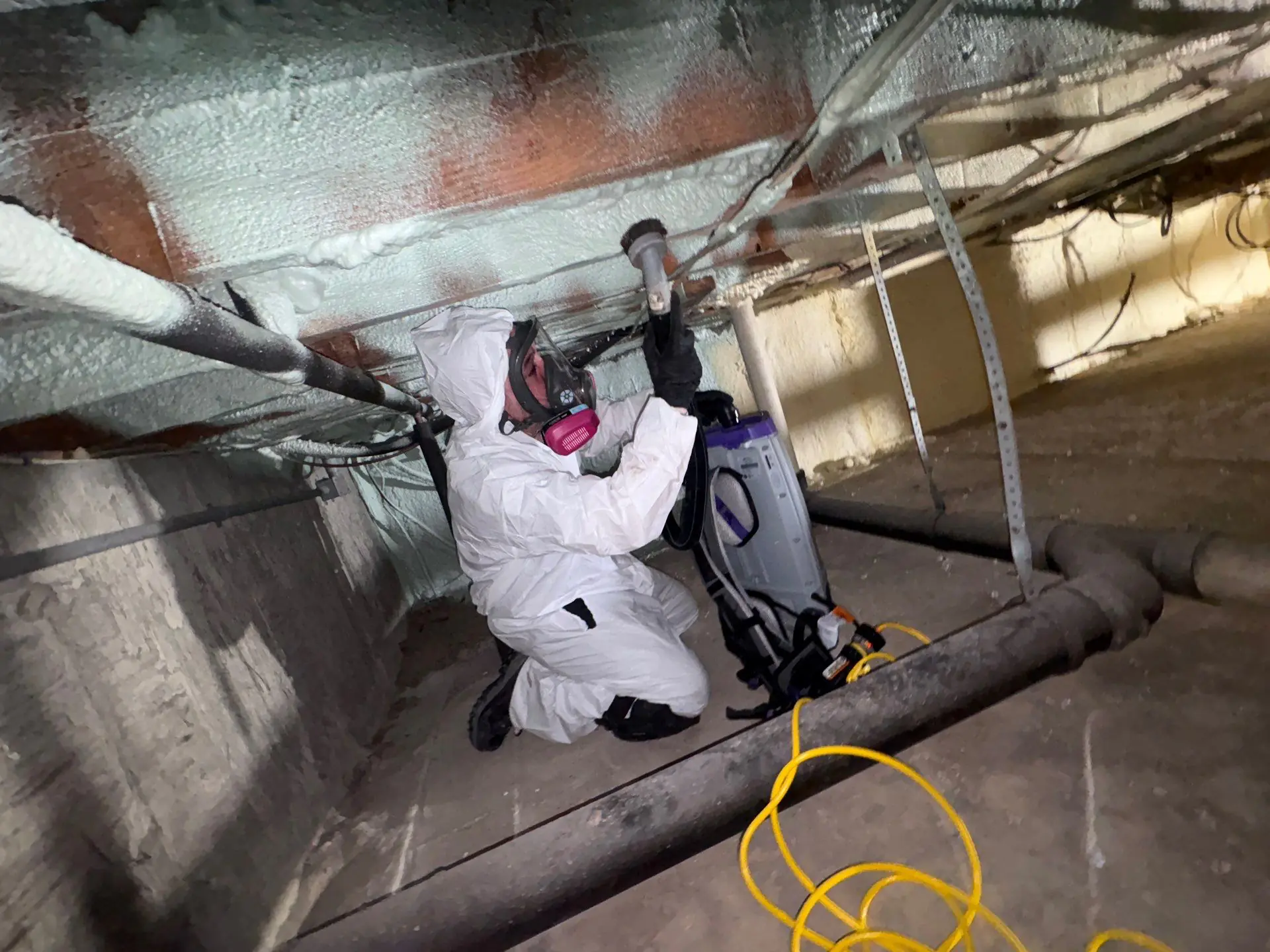
The most common abatement in pre-1980 Long Island basements: white or gray lagging on steam and hot-water heating pipes, and the jacket on old oil boilers. It's friable, so it's full containment and wet removal — usually found when the boiler is replaced or a pipe leaks, and a plumber who finds it has to stop until it's handled.
Asbestos floor tile & black mastic
9×9 vinyl-asbestos tile in finished basements and kitchens, and the black cutback adhesive under it. The tile comes up intact; the mastic is ground or solvent-removed and is the slow part. Common before a basement finish or a sale — or after a flood soaks the tile.
Asbestos siding, shingles & popcorn ceilings
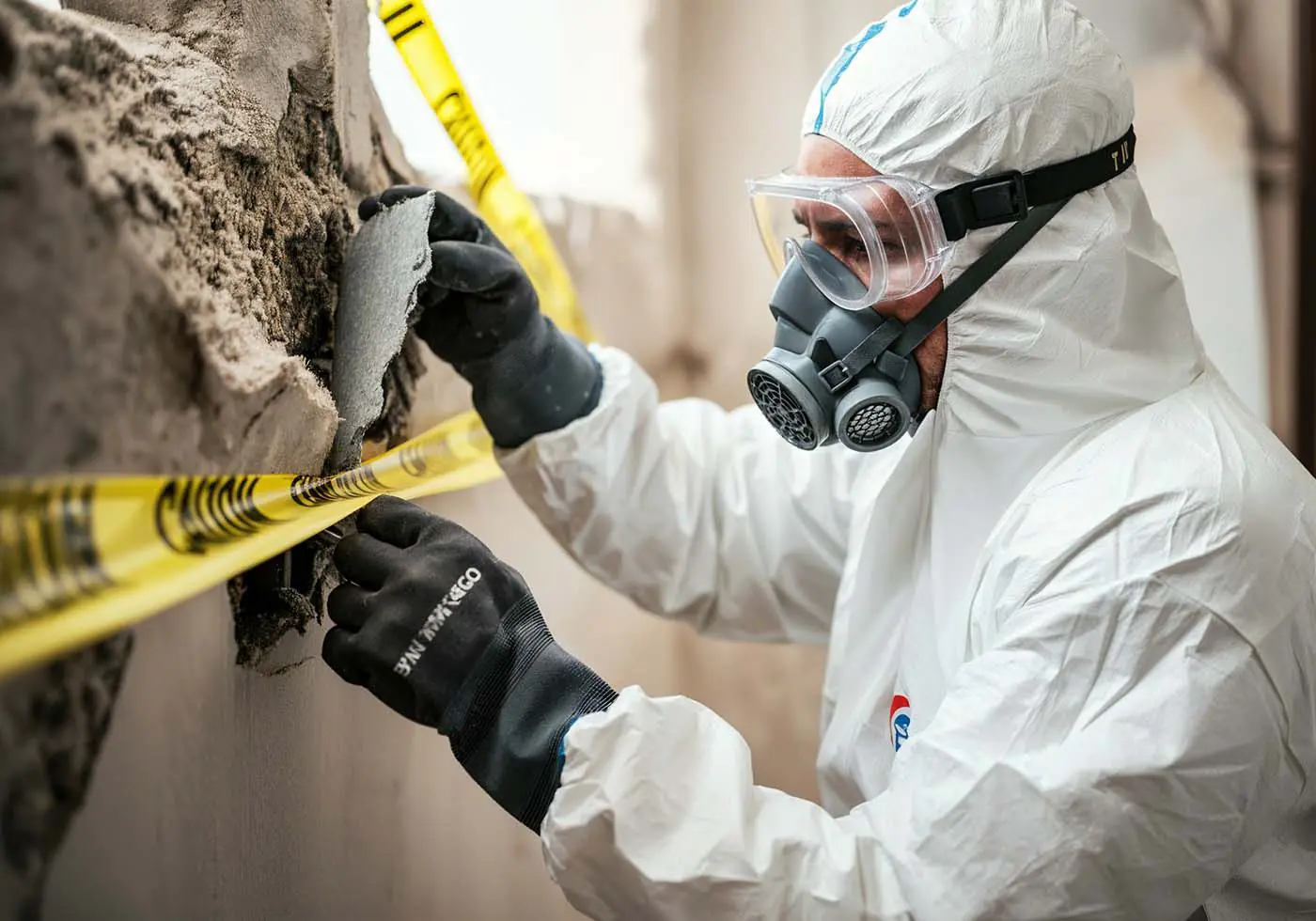
Transite cement shingles on capes and colonials, asbestos roofing felt, and sprayed or textured ceilings. Intact siding is non-friable and can often be covered instead of removed; cracked shingles and ceilings that will be cut or scraped come out. A licensed inspector's report makes the call.
Vermiculite insulation & duct wrap
Zonolite vermiculite in attics and paper-wrapped ductwork in mid-century houses. Both get disturbed by HVAC and insulation work, which is how most homeowners find them — so have it sampled before anyone climbs into the attic or opens the ducts.
What asbestos abatement includes.
Asbestos abatement is the removal or encapsulation of asbestos-containing material by a licensed contractor inside sealed, negative-pressure containment, with the material kept wet, double-bagged, and disposed of at a permitted landfill — verified by independent air clearance before the area is reopened.
On Long Island, K.O.S. Restoration does it in five steps under New York’s Industrial Code Rule 56, with the inspection and the clearance performed by independent licensed firms, as the law requires.
Independent survey and sampling
A NYS-licensed asbestos inspector — a separate company, by law — samples the suspect material and sends it to a lab. If you're renovating or demolishing, New York requires this survey before work starts, whatever the material turns out to be.
Notification and plan
Jobs over the state's size thresholds are filed with the Department of Labor ten days ahead. K.O.S. writes the abatement plan: what's being removed, how it's contained, where the waste goes.
Containment and negative air
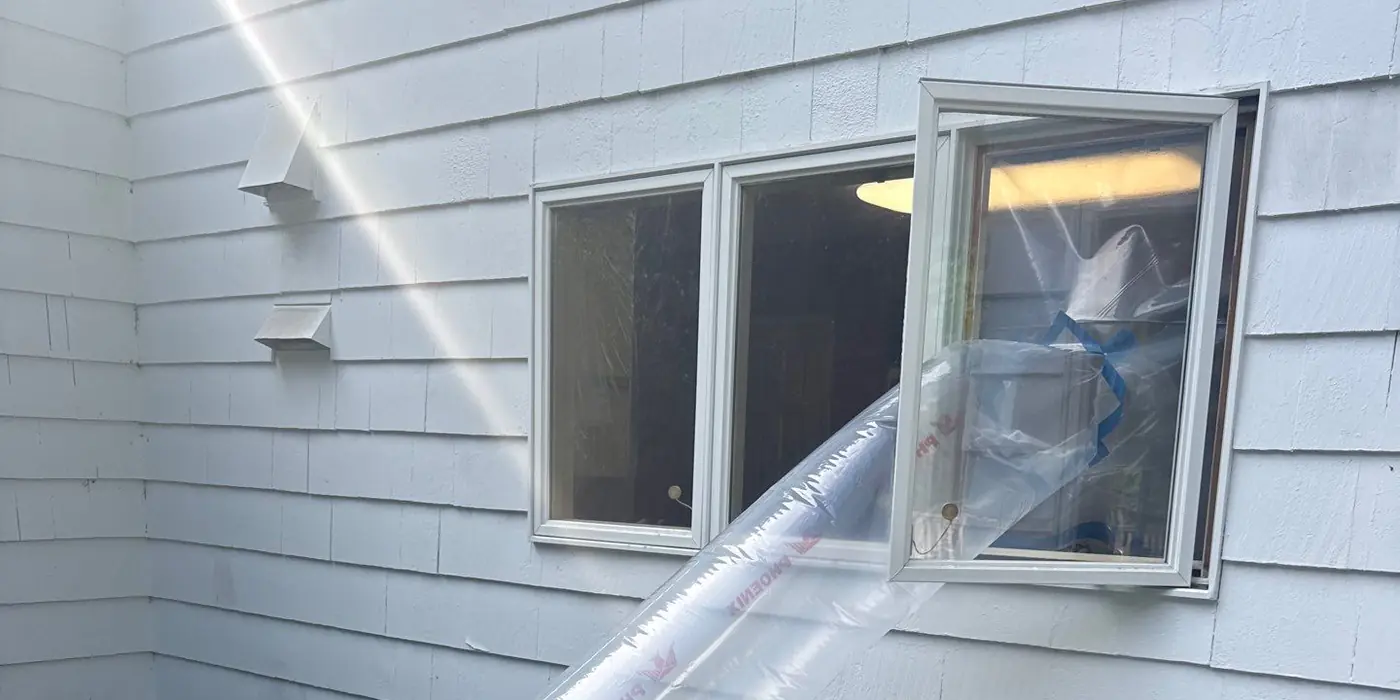
The work area is sealed in polyethylene with a decontamination unit at the entry, HEPA-filtered negative-air machines exhausting outside, and the HVAC isolated. Certified handlers in respirators and disposable suits.
Wet removal, sealed disposal
Material is kept wet so fibers don't go airborne, removed intact where possible, double-bagged in labeled asbestos waste bags, and taken to a permitted landfill with a manifest you keep.
Clean, clear, document
HEPA vacuuming and wet wiping of every surface in containment, then an independent project monitor takes air samples. Containment comes down only when the air passes. You get the lab results, the manifest, and the clearance.
What it costs, and how long it takes.
Most residential abatement on Long Island is one to three days inside containment, plus the survey before and the clearance after. Cost is driven by quantity, whether the material is friable, and access — not by the size of the house.
Insurance pays when a covered loss forces the abatement; it doesn’t when you elect to do it. Either way, K.O.S. gives you a written scope after the survey with every line item shown.
Abatement is priced by the linear feet of pipe, the square feet of tile or siding, or the number of boiler jackets — plus the fixed cost of setting up containment and decontamination, which is the same whether it's 20 feet of pipe or 200.
- Small jobs carry the setup cost: containment, negative air, decon unit
- Pipe insulation: by the linear foot, more for elbows and valves
- Tile and mastic: by the square foot; mastic removal is the slow part
Crumbly, friable material — pipe lagging, boiler insulation, sprayed ceilings — needs full containment and takes longer. Non-friable tile, siding, and roofing can sometimes be removed intact with less setup.
A boiler room with a door is straightforward. Pipes threaded through a finished ceiling, or a crawlspace, mean more containment, more time, and sometimes removing finishes to reach the material.
The independent inspector's survey and the project monitor's air clearance are separate line items from separate companies; landfill disposal is charged by weight. All three are on the scope up front, none of them are marked up by K.O.S.
The inspector's visit is an hour or two; lab results are typically back within a few days. For a renovation, this is the step your contractor's permit depends on.
Above the state's thresholds, the Department of Labor gets ten days' notice before work starts. Small jobs — a few feet of pipe, one boiler — can move faster. Emergencies (a burst pipe under asbestos lagging) have their own process.
Most residential abatement is a day or two inside containment: a basement of pipe insulation, a floor of tile, a boiler. Larger or multi-area jobs run longer.
Air clearance by the independent monitor the same day removal finishes; the containment comes down when it passes. Waste manifest, lab results, and clearance letter to you within days — the file your contractor, buyer, or insurer will ask for.
New York requires anyone disturbing asbestos to hold a Department of Labor Asbestos Handling License, with certified workers and supervisors on site, and requires a licensed inspector's survey before any renovation or demolition of a pre-1974 building. The inspector and the air monitor must be independent of the abatement contractor.
Abatement you choose to do — for a renovation, a sale, peace of mind — is not covered. Abatement that a covered loss forces — a burst pipe that soaked asbestos lagging, a fire, a flood through a tiled basement — usually is, as part of that claim. The distinction is the cause.
Intact, undisturbed asbestos is often best left alone or encapsulated: siding can be covered, tile can be floored over, pipe lagging can be wrapped. Removal is required when the material is damaged, friable, or in the way of work. A licensed inspector's report is what tells you which.
A written scope after the survey, with the inspector, monitor, and disposal shown separately. On a covered loss, your deductible; K.O.S. bills the carrier directly and the manifest and clearance go to the adjuster.
Containment, negative air, and nobody in without a suit.
Every abatement runs inside polyethylene containment with a decontamination unit at the door and HEPA-filtered negative-air machines exhausting outside, so the pressure in the work area is always lower than the house around it.
Certified handlers in respirators and disposable suits keep the material wet from the first cut to the last bag. Then an independent monitor samples the air, and the plastic comes down only when it passes.
Asbestos on Long Island is a housing-stock problem.
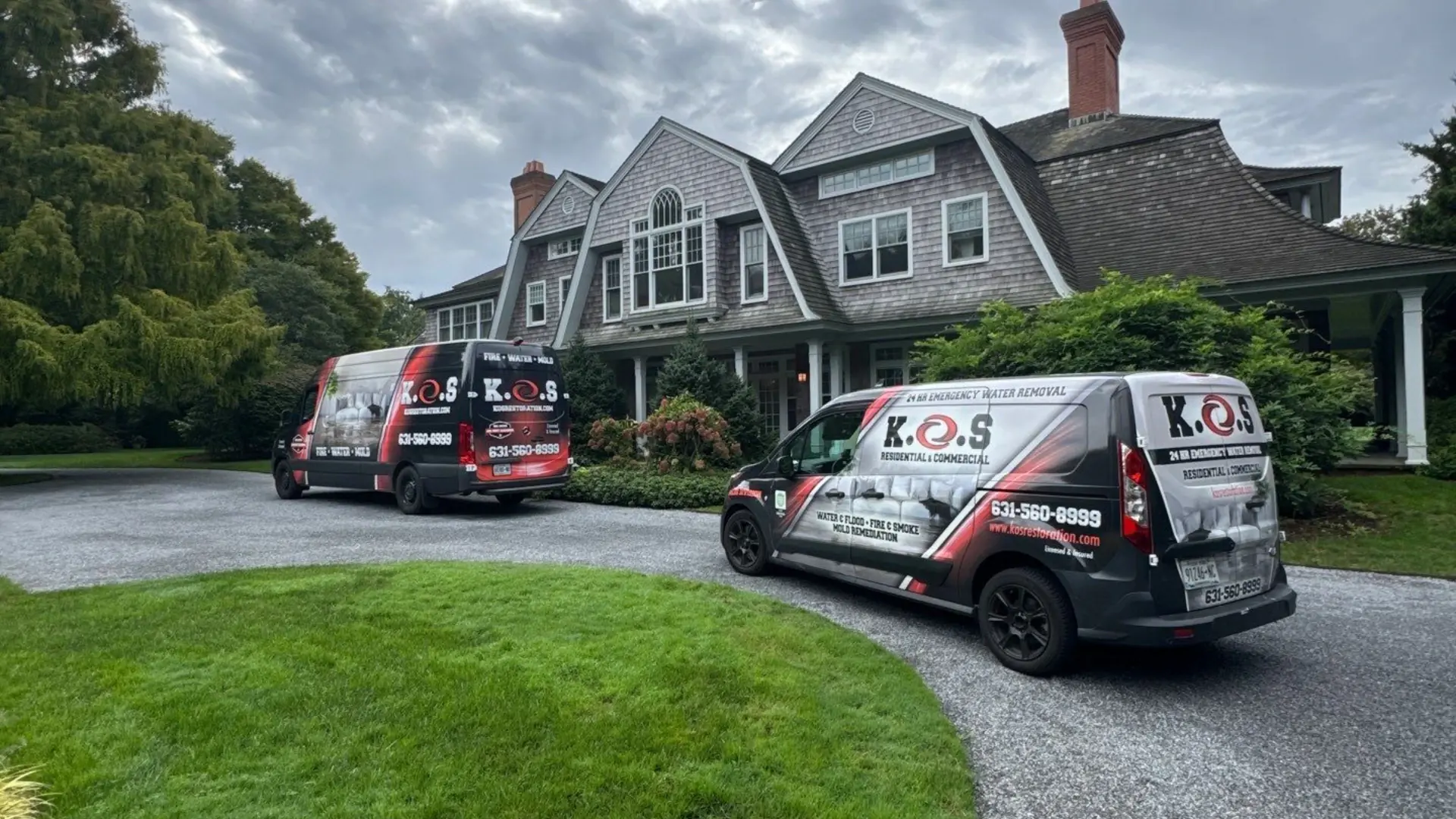
K.O.S. Restoration has abated basements, crawlspaces, and boiler rooms across Suffolk, Nassau, and Queens from Bellport since 2006. The Island was built in asbestos’s decades, and most of the houses are still standing.
Crews dispatch from Bellport. Find your town on the service-area pages:
- Suffolk County
- The Hamptons & East End
- Nassau County
- Queens
The housing stock is the reason
Long Island was built out between 1945 and 1975 — Levittown, the capes and splits of Nassau, the ranches of western Suffolk. That is exactly the era of asbestos pipe lagging, 9×9 tile, transite siding, and vermiculite. Most pre-1980 houses here have at least one.
Oil heat means boilers and pipe wrap
Steam and hot-water heat off an oil boiler is the norm in older Suffolk homes. Every boiler swap and every burst pipe in a basement ceiling is a potential abatement, and a plumber who finds lagging has to stop until it's handled.
Basement finishes and sales
Finishing a basement, replacing a boiler, or listing a house are the three moments Long Island homeowners meet asbestos. A buyer's inspector will flag pipe wrap; a permit will require a survey. Planning for it beats discovering it mid-job.
Water damage exposes it
A burst pipe or a flooded basement soaks asbestos tile, mastic, and lagging — and a water loss can't be dried around friable asbestos. That's the case where abatement is part of an insurance claim, and why a restoration company needs the license.
Insurance handled
Insurance pays for abatement a covered loss forces — not abatement you choose.
A burst pipe that soaked the lagging, a fire, a flood through a tiled basement: the abatement is part of that claim, and K.O.S. scopes it in Xactimate with the water or fire work. A renovation or a sale is on you — with a written scope up front and no markup on the inspector, monitor, or disposal.
- State Farm
- Allstate
- Liberty Mutual
- GEICO
- USAA
- Travelers
- Mercury
- Mutual of Omaha
- Zurich
300+ neighbors have already called.
A 5.0 rating across Suffolk County. Read every review on Google.
Asbestos questions
The questions people ask Google about asbestos removal on Long Island — including what a small job costs and whether you can just cover it — answered plainly.
What does asbestos abatement include?
An independent licensed inspector's survey and lab results; notification to the Department of Labor for jobs above the state thresholds; sealed containment with negative air and a decontamination unit; wet removal by certified handlers; double-bagged disposal at a permitted landfill with a manifest; HEPA cleaning; and air clearance by an independent project monitor before containment comes down. K.O.S. does the removal; the inspector and the monitor are separate companies, as New York requires.
How much does it cost to get rid of a small amount of asbestos?
Small jobs are priced mostly by the setup — containment, negative air, decontamination, and disposal are the same whether it's a few feet of pipe or a whole basement — so the first job is the most expensive per foot. A short run of pipe lagging or a single boiler is a one-day job. The inspector's survey and the monitor's clearance are separate line items from separate companies. K.O.S. consults free and gives a written scope after the survey.
Does asbestos removal cost a lot?
Compared to the renovation it's usually part of, rarely. A basement of pipe insulation or a floor of tile is typically a one-to-three-day job with fixed setup and per-foot removal; the number depends on quantity, whether the material is friable, and access. What costs a lot is disturbing it without abatement — contaminated air, a stopped renovation, and a much larger cleanup.
Can asbestos be 100% removed?
From the material being abated, yes — that's what the independent air clearance verifies before the containment comes down. From a house, only if every asbestos-containing material is removed, which is rarely necessary. Intact, undisturbed asbestos is not a hazard; the survey tells you what has to go and what can stay or be encapsulated.
Will insurance pay for asbestos abatement?
Not when you choose to do it — for a renovation, a sale, or peace of mind. Usually yes when a covered loss forces it: a burst pipe that soaked the lagging, a fire, a flood through a tiled basement. The abatement becomes part of that claim, and K.O.S. scopes it in Xactimate alongside the water or fire work.
Can I just cover asbestos siding?
Often, yes. Intact transite siding is non-friable and can be encapsulated — covered with new siding over a housewrap — which is cheaper and safer than removal. Removal is required if the shingles are cracked and shedding, or if the work you're doing (windows, sheathing) means cutting into them. A licensed inspector's report is what makes the call.
Does K.O.S. do asbestos testing?
No — New York requires the inspector who samples and the contractor who removes to be independent, the same way mold assessment works. K.O.S. coordinates a NYS-licensed asbestos inspector for the survey and an independent project monitor for the air clearance, and handles the abatement in between. Never hire one company to do all three.
Is asbestos dangerous if it's undisturbed?
Generally not. Asbestos is a hazard when fibers are airborne, which takes damage or disturbance — cutting, sanding, drilling, water damage, or crumbling with age. Intact tile under a floor or wrapped pipe in a dry basement is usually left alone. The risk is work done without knowing it's there, which is why the survey comes before renovation.
Find out what’s there before the work starts.
Real person · 24/7 · 45-minute response
Start the clock(631) 560-8999