Water Damage & Mold Remediation in Westhampton Beach, NY — Pipe Break Case Study
K.O.S. Restoration responds to a pipe break at a Westhampton Beach home — full water damage and IICRC S520 mold remediation case study including crawlspace flooding.
Tom Cwalinsky··8 min read·Westhampton Beach, NY
The short answer
A hot water pipe burst in an upper-floor Westhampton Beach condominium, sending water through the kitchen ceiling into the unit below and down into a shared crawlspace. K.O.S. Restoration deployed within hours, performed IICRC S500-compliant structural drying with an LGR 6000 dehumidifier and high-velocity air movers, and discovered active mold growth on crawlspace floor joists. Full IICRC S520 mold remediation — including negative-pressure containment, HEPA air scrubbing, and antimicrobial treatment — was completed before reconstruction.
A hot water pipe burst in an upper-floor Westhampton Beach condominium, sending water through the kitchen ceiling into the unit below and down into a shared crawlspace. K.O.S. Restoration deployed within hours, performed IICRC S500-compliant structural drying with an LGR 6000 dehumidifier and high-velocity air movers, and discovered active mold growth on crawlspace floor joists. Full IICRC S520 mold remediation — including negative-pressure containment, HEPA air scrubbing, and antimicrobial treatment — was completed before reconstruction.
Project at a Glance
Emergency Response
The call came in on a weekday morning: a hot water supply pipe had failed in an upper-floor unit of a Westhampton Beach condominium complex, sending water through the floor and into the kitchen ceiling of the unit directly below. By the time K.O.S. Restoration arrived on scene, the damage was visible everywhere — soaked drywall, a buckled ceiling, standing water pooled on the kitchen floor, and saturated cabinets from countertop to ceiling.
Our crew began with a full moisture inspection of the affected unit. Using a calibrated moisture meter, we documented readings across the kitchen flooring, cabinetry, and walls. The most telling reading came from the hardwood flooring near the fireplace — 17.7
, well above the threshold for structural concern and indicating deep saturation that had migrated beyond the immediate impact zone. At elevated coastal humidity levels — common in Westhampton Beach's proximity to Moriches Bay — materials dry significantly slower than in inland environments, making rapid equipment deployment critical.
How the Water Damage Spread
Water damage rarely stays in one place. In this case, the pipe failure above allowed a sustained flow of hot water that followed the path of least resistance — through floor framing, down into the ceiling cavity of the kitchen below, and ultimately into the crawlspace beneath the structure. Gravity and time worked against the homeowner. The affected areas included:
Kitchen ceiling drywall — fully saturated, with sections collapsed
Kitchen ceiling joists — soaked and in direct contact with standing water
Upper kitchen cabinets — water intrusion along cabinet tops and interior shelving
Hardwood flooring throughout the kitchen — deep moisture penetration
Crawlspace floor joists and subfloor sheathing — standing water and prolonged moisture exposure
Once the compromised ceiling drywall was removed, the extent of the water intrusion became fully apparent. The floor joists above were visibly stained, and the plumbing that had failed was now exposed. The demolition phase — necessary under IICRC S500 guidelines to remove all unsalvageable materials and allow structural components to dry — also confirmed that water had been travelling laterally well beyond the ceiling's visible wet zone.
The wide-angle view from the kitchen doorway told the full story: an open ceiling cavity, a ladder positioned for continued demo work, and materials stacked for disposal. In condo settings, this type of water migration is especially problematic because the affected materials are shared structural elements — what damages the ceiling of one unit may simultaneously compromise the floor structure of another.
Drying and Dehumidification
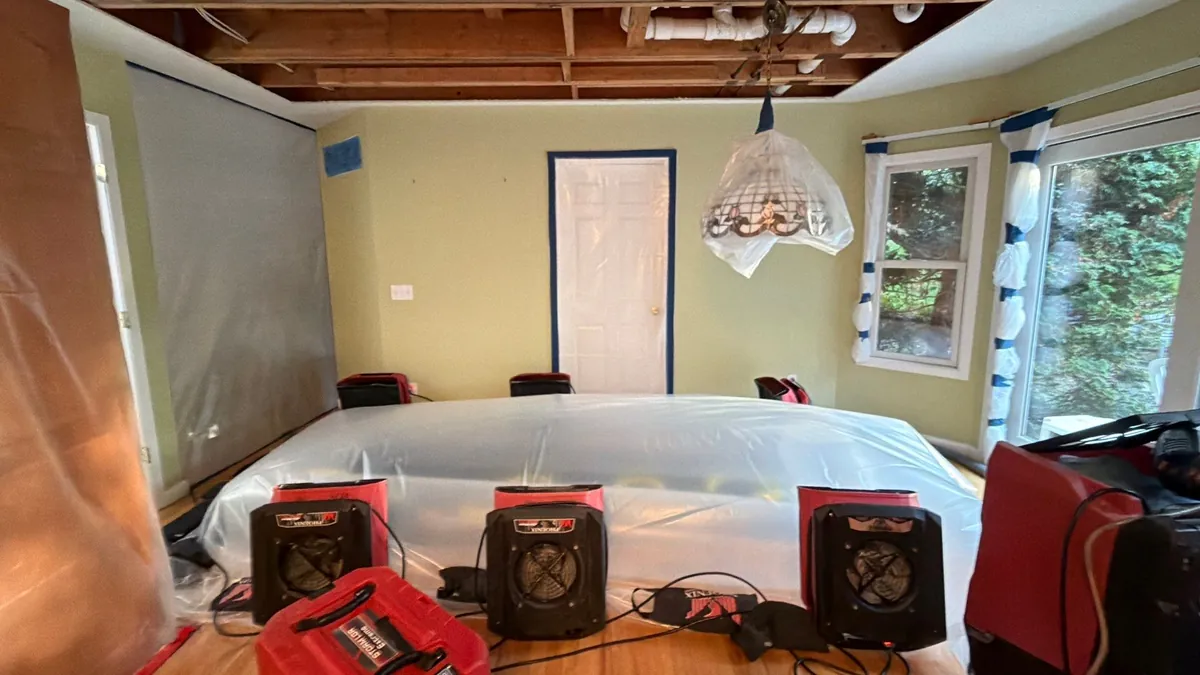
With demolition complete and all unsalvageable materials removed, K.O.S. Restoration deployed a commercial drying system in the kitchen. An LGR 6000 low-grain refrigerant dehumidifier was positioned to pull moisture from the air at high capacity, paired with high-velocity air movers aimed at the exposed ceiling joists, subfloor, and cabinet openings. Readings were logged daily against a drying goal established per IICRC S500 standards — returning structural materials to pre-loss moisture content or within acceptable regional norms for coastal Long Island.
Simultaneously, a second commercial dehumidifier was deployed into the crawlspace, where conditions were far more challenging. The enclosed, low-clearance environment had trapped humidity and standing water, creating a near-ideal environment for mold proliferation. Crawlspace drying requires specialized equipment positioning and extended run times — in this case, the unit ran continuously with daily monitoring to track progress against the drying log.
Mold Growth Discovered
During the crawlspace inspection, our technicians identified active mold growth on the floor joists — a finding that, while serious, is not uncommon in Long Island crawlspaces that have experienced water intrusion. The mold presented in multiple stages and species: heavy black and brown staining consistent with early-stage colonization, alongside bright orange growth indicating an active, spreading colony. According to the EPA, mold can begin to develop on wet building materials within 24 to 48 hours of initial water exposure — and in a sealed crawlspace, conditions accelerate that growth timeline.
A close-up inspection of the structural framing revealed the full picture: orange and white mold colonies had established themselves on the wood framing, with visible surface coverage across multiple joists. This type of visible mold growth on structural wood always requires professional remediation — surface cleaning alone is insufficient, as mold hyphae penetrate into the wood grain and will regrow without proper treatment and moisture control.
The remediation scope now extended beyond water damage restoration into full IICRC S520 mold remediation protocol. All mold-contaminated insulation and drywall debris was carefully removed, bagged in 6-mil polyethylene, and disposed of per New York State Department of Environmental Conservation guidelines. The removed materials were staged on the subfloor for documentation before removal from the structure.
Preparing for IICRC S520 Remediation
IICRC S520 — the Standard and Reference Guide for Professional Mold Remediation — establishes a specific set of engineering controls that must be in place before any remediation work begins. These controls exist to prevent cross-contamination: mold spores disturbed during cleaning and treatment can become airborne and spread to unaffected areas of the structure if the work area is not properly isolated.
The first control established was a full polyethylene containment barrier sealing off the affected hallway and crawlspace access area. The barrier was taped at all seams and ran floor-to-ceiling, with a zipper entry point for technician access. This creates the boundary of the regulated remediation zone — nothing exits this area without proper decontamination.
With containment in place, a K.O.S. branded HEPA air scrubber was positioned inside the zone and set to create negative air pressure — meaning air is continuously exhausted out of the containment area through a HEPA filter, preventing mold spores from migrating into clean areas of the home. The combination of containment barriers, negative pressure, and HEPA filtration is the industry standard protocol under S520 and is required for any significant mold remediation scope.
Why Crawlspace Water Damage Should Never Be Ignored
Crawlspaces are the most overlooked area of any home — and the most vulnerable to water damage and mold. In this Westhampton Beach project, the crawlspace transformed from a dry utility space to a standing-water environment within hours of the pipe failure. The image below documents conditions at their worst: visible standing water pooled across the crawlspace floor, saturating the vapor barrier and reaching the base of the structural framing.
Once standing water reaches the framing, the clock starts for mold development. In coastal environments like Westhampton Beach — where ambient relative humidity is already elevated due to proximity to Moriches Bay and the Atlantic — mold colonization can establish within 24 hours rather than the 48-hour window cited for inland climates. Left unaddressed, crawlspace mold compromises indoor air quality throughout the entire living space above, as the natural air movement in a home draws crawlspace air upward through the floor system.
Water Damage in Westhampton Beach Condominiums
Westhampton Beach's condominium stock includes a significant number of units built between the 1970s and 1990s — a construction era that predates modern flexible piping materials and updated plumbing codes. Aging copper supply lines and galvanized drain pipes in these properties carry an elevated risk of failure, particularly at joints and where pipes penetrate floor assemblies. When a pipe fails in a multi-unit building, the damage rarely stays contained to one unit — water travels through shared framing and creates liability questions across multiple ownership interests.
The coastal climate compounds the challenge. Westhampton Beach sits along the south shore of Long Island, bordered by Moriches Bay and exposed to Atlantic weather systems that bring sustained periods of elevated humidity. During these conditions, structural drying timelines extend, and any moisture that isn't aggressively addressed by professional drying equipment will find equilibrium at a level that supports mold growth. Homeowners and property managers in this area should be especially vigilant after any water intrusion event — even minor leaks can become major mold problems within days.
Water Damage or Mold in Your Home? Call K.O.S. Restoration
K.O.S. Restoration responds 24/7 to water damage and mold emergencies across Long Island and the Hamptons. Our technicians are trained to IICRC S500 and S520 standards — the same protocols used in this Westhampton Beach case study.
The things people ask when they're looking at the same problem.
How quickly does mold grow after water damage?+
Mold can begin to colonize wet building materials within 24 to 48 hours of initial water exposure, according to the EPA. In high-humidity coastal environments like Westhampton Beach, NY — where ambient moisture levels are elevated — this timeline can be shorter. Rapid professional drying and remediation is the only reliable way to prevent mold growth after a water damage event.
What is IICRC S520 mold remediation?+
IICRC S520 is the industry standard for professional mold remediation, published by the Institute of Inspection, Cleaning and Restoration Certification. It defines the engineering controls, containment requirements, personal protective equipment, remediation procedures, and clearance criteria that must be followed during a mold remediation project. Work performed to S520 standards includes negative-pressure containment, HEPA filtration, proper disposal of contaminated materials, and post-remediation verification.
Can a pipe break in an upstairs unit damage the unit below?+
Yes — and it's one of the most common causes of water damage in multi-unit condominiums. When a pipe fails in an upper unit, water travels through the floor assembly and into the ceiling cavity of the unit below. Depending on how long the pipe ran before being shut off, water can saturate drywall, flooring, framing, cabinets, and — as in this Westhampton Beach case — travel all the way into the crawlspace beneath the structure.
Do I need professional drying equipment, or can I use fans?+
Consumer fans circulate air but don't remove moisture from it. Professional structural drying requires commercial-grade low-grain refrigerant (LGR) dehumidifiers capable of extracting large volumes of moisture from the air, paired with high-velocity air movers that accelerate evaporation from structural surfaces. The IICRC S500 standard establishes specific drying goals — returning materials to pre-loss moisture content — that consumer equipment cannot reliably achieve, especially in coastal environments.
Is crawlspace mold dangerous?+
Yes. Crawlspace mold is a serious indoor air quality concern because homes naturally draw air upward through the floor system — a phenomenon known as the "stack effect." Mold spores, mycotoxins, and elevated humidity from a contaminated crawlspace migrate into living areas above, potentially affecting occupant health and contributing to ongoing moisture problems in finished areas of the home. Professional IICRC S520 remediation is required to properly address crawlspace mold.